Discomfort under chewing pressure almost always means force is reaching a nerve it should not reach. The trigger could be minor, like a filling sitting a hair too high, or something that needs attention soon, like a fractured tooth or an infected root.
This guide covers the 10 most common causes, a symptom chart to help you narrow yours down, the warning signs that call for same-day care, and what you can do before your appointment.
Key Takeaways
- Pain under chewing pressure is almost always one of ten identifiable problems: a cracked tooth, cavity, high restoration, gum disease, abscess, TMJ disorder, sinus pressure, dental injury, malocclusion, or impacted wisdom teeth.
- A cracked tooth is the hardest of these to diagnose because hairline fractures rarely show on X-rays, but the release-of-pressure pattern, where biting hurts and letting go hurts more, is a reliable clue to report to your dentist.
- Urgency depends on the cause. A high filling takes minutes to adjust, while an abscess with swelling, fever, or a foul taste needs same-day treatment.
- Desensitizing toothpaste, warm salt water rinses, and over-the-counter anti-inflammatories can dull the discomfort temporarily, but none of them treat the cause or stop it from progressing.
- This kind of soreness rarely clears up on its own. Waiting usually turns a simple fix into a bigger one.

What Your Teeth Pain Is Trying to Tell You
Chewing discomfort is not the problem itself. It is a signal that something has gone wrong with a tooth, its root, the surrounding gum, or the bone underneath.
Ignore it and that same issue tends to escalate. A hairline fracture becomes a full split. A small cavity reaches the nerve. An early infection turns into an abscess that costs you the tooth. Getting checked early almost always means a simpler fix.
10 Most Common Reasons Your Teeth Hurt When You Bite Down
These are the most likely explanations for pressure-related dental pain. Knowing what separates one from another helps you judge how fast you need to act.
Cracked or Fractured Tooth
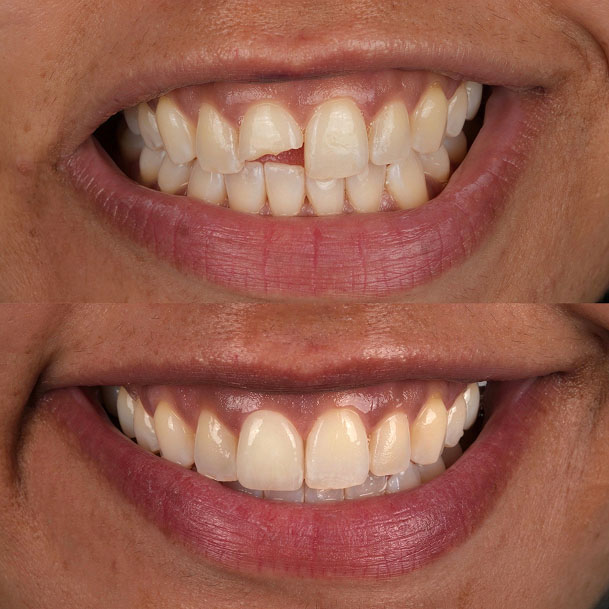
A cracked tooth is one of the hardest dental problems to diagnose because hairline fractures are often invisible on X-rays. Cracks typically develop from chewing on ice or hard foods, teeth grinding (bruxism), or stress placed on a tooth during previous dental work.
The hallmark symptom is a sharp, brief burst of discomfort when biting that disappears quickly once you release pressure. That release-of-pressure pattern, where biting hurts but letting go hurts more, is called cracked tooth syndrome. If you feel it on one side while eating, a fractured tooth is a strong possibility.
Depending on how deep the crack goes, treatment may range from a dental crown to a root canal. The sooner it is caught, the more of the tooth can be saved.
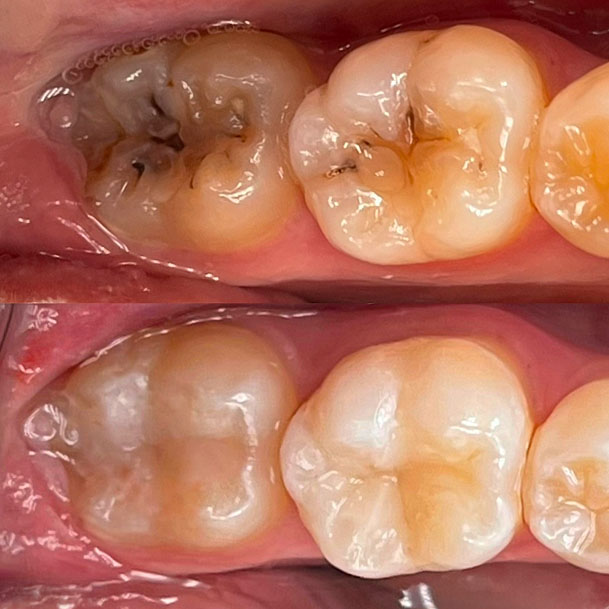
Cavities or Tooth Decay
Decay does not always announce itself until it reaches the deeper layers of the tooth. According to the National Institute of Dental and Craniofacial Research, 92% of adults aged 20 to 64 have had dental caries in their permanent teeth.
Once decay reaches the pulp, the nerve-containing center of the tooth, chewing pressure can trigger a sharp response.
Common signs include spontaneous aching, sensitivity to sweets, or a visible dark spot. If food keeps packing into the same spot, that is worth paying attention to.
Early decay usually needs nothing more than a cavity filling rather than a crown or root canal, so catching it early saves both the tooth and the cost.
Loose or High Dental Fillings or Crowns
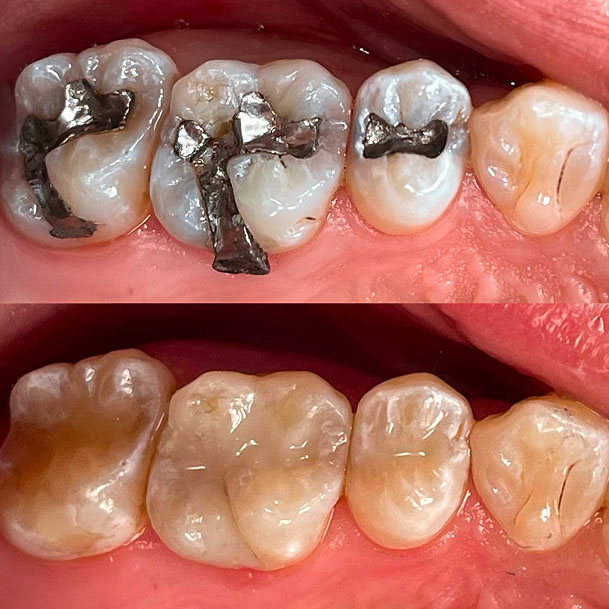
When a filling or crown sits slightly too high, it changes how your upper and lower teeth meet. That one spot absorbs more force than it should, leaving the treated tooth sore and sometimes the opposing tooth as well.
This is one of the most common complaints after dental work. The fix is fast: your dentist marks the high point with articulating paper and adjusts the restoration in minutes.
If you are also weighing what a crown replacement or new restoration might cost, our guide to dental crown costs in NYC breaks it down. Leaving a high bite uncorrected can lead to cracking or joint problems over time.
Gum Disease and Recession
If the sensitivity shows up near the gumline while you chew, periodontal disease may be behind it. Inflammation, gum detachment, or recession can expose the root surface. Unlike the crown of a tooth, the root has no enamel shielding it, so it reacts far more to pressure and temperature.
Advanced gum disease (periodontitis) can also produce swollen gums around one tooth, bleeding, and pockets of infection below the gumline. During an exam, your dentist or hygienist measures the attachment levels around each tooth to gauge how much support has been lost.
If you have already been diagnosed with periodontal disease, our guide on teeth longevity with periodontal disease covers what to expect and how to protect what you still have.
Infected Tooth or Abscess
An abscess forms when bacteria reach the pulp, the soft tissue at the center of the tooth holding the nerves and blood vessels. The infection creates swelling inside the bone around the root tip, and that trapped pressure is what makes chewing feel unbearable.
A tooth that hurts to touch is one of the clearest signs. If tapping it with a fingernail or your tongue sets off a deep ache, the ligament around the root is inflamed, which points to infection rather than simple sensitivity.
Look for a pimple-like bump on the gum near the sore tooth (called a fistula), a bad taste, or swelling in the jaw or face. An abscess will not resolve on its own.
According to the American Association of Endodontists, root canal treatment is the standard approach for saving an abscessed tooth. If you are unsure whether your case is urgent, read Is a root canal an emergency for a clear breakdown.
If swelling, fever, or difficulty swallowing develops, you may need emergency root canal treatment and should be seen the same day.
Misaligned Bite (Malocclusion)
When your upper and lower jaws do not meet evenly, certain teeth absorb more force than the rest during chewing. Over time that uneven load wears down enamel and leaves the overloaded teeth chronically sore.
Malocclusion can be hereditary or develop after a lost tooth, an ill-fitting restoration, or shifting that happens once orthodontic treatment ends. Depending on severity, the correction may be a simple bite adjustment, a new restoration, or orthodontic work.
TMJ Disorders
The temporomandibular joint (TMJ) connects your jawbone to your skull and controls how your mouth opens and closes. When that joint is inflamed or out of position, it can create discomfort across the jaw, face, and teeth even when every tooth is perfectly healthy.
Signs of a TMJ disorder include morning jaw stiffness, a clicking or popping sound when you open wide, and a general ache spread across several teeth. Grinding and clenching during sleep are common contributors.
A custom night guard can take pressure off the joint and protect your enamel from further wear. Learn more about TMJ treatment options available at Smile Lab.
Sinus Pressure or Infection
This one catches people off guard. Your upper molars sit directly beneath the maxillary sinus cavities, so when those sinuses are inflamed or congested, the pressure registers as tooth pain in the upper back teeth.
The telltale sign that sinuses are responsible: several upper teeth ache at once instead of one specific tooth, and the pressure worsens when you bend forward or change elevation, like descending in a plane. Dental X-rays can rule out a tooth problem, and treating the sinus infection usually clears the dental symptoms.
Dental Injury
A chip, crack, or impact, even one that looks minor, can bruise the periodontal ligament that holds the tooth in its socket. That leaves the tooth tender under pressure, much like a bruised finger feels sore to the touch.
These injuries most often come from accidents, contact sports, or biting down on something unexpectedly hard. Even if the tooth looks intact afterward, have it evaluated; our guide to how dentists repair cracked teeth explains what that involves. An injured tooth left unchecked can develop nerve damage or infection later.
Impacted Wisdom Teeth
If the soreness sits in the very back of your mouth near your molars, impacted wisdom teeth may be the source. Wisdom teeth, also called third molars, typically emerge between ages 17 and 25.
When there is not enough room for them to come in properly, they grow at an angle and push against the neighboring teeth. That pressure causes aching in the surrounding area, especially while chewing, which is why the back of your mouth can hurt when you bite down even though no single tooth looks damaged.
The tissue over a partially erupted wisdom tooth can also trap bacteria and become infected, a condition called pericoronitis.
Extraction is the most common solution, and most people recover within a few days. For what that procedure costs, see our breakdown of wisdom tooth removal costs.
Match Your Symptoms to the Likely Cause
Pain patterns are diagnostic. How the discomfort behaves, and which teeth it affects, narrows the list fast. Use this chart to see where your symptoms land, then confirm it with an exam.
| What you feel | Most likely cause | How soon to act |
|---|---|---|
| Sharp jolt when you release the bite | Cracked tooth | Within days |
| Pain with sweet, hot, or cold foods | Cavity reaching the dentin | Within days |
| One tooth hits before the others | High filling or crown | Within days |
| Constant throb, swelling, bad taste | Abscess or root infection | Same day |
| Tooth hurts to touch or tap | Inflamed ligament or infection | Same day |
| Bleeding gums, teeth feel loose | Gum disease or recession | Within weeks |
| Several upper teeth ache at once | Sinus pressure or infection | Within weeks |
| Soreness worst in the morning, jaw fatigue | Grinding or TMJ disorder | Within weeks |
| Aching at the very back of the mouth | Impacted wisdom tooth | Within weeks |
| Tenderness after a knock or fall | Bruised periodontal ligament | Within days |
No chart replaces an exam, but walking in with a clear description of your pattern helps your dentist reach the answer faster.
Signs When Bite Pain May Need Attention
Not every twinge is an emergency, but knowing which category you fall into tells you whether to call today or book for next week.
See a dentist within a few days if you notice:
- Soreness that lingers after eating or chewing
- Tenderness or puffiness in the gums around one tooth
- A sharp reaction to hot, cold, or sweet foods
- A tooth that feels higher than the others when your teeth meet
- Aching that has been building over several days
Call for same-day care if you have any of these:
- Severe pain that over-the-counter medication will not touch
- Visible swelling in the gum, face, jaw, or neck
- Fever alongside the tooth pain
- Pus, drainage, or a foul taste that keeps returning
- A tooth that has turned noticeably darker than its neighbors
- Any difficulty swallowing or breathing
That second list points to active infection, which spreads. Any of those symptoms alongside bite sensitivity needs a professional assessment from an emergency dentist in Union Square, not another dose of pain reliever.
At-Home Tips for Temporary Relief
While you wait for your appointment, these steps can make eating manageable without masking a worsening problem. For a fuller breakdown of what works, see our guide on emergency tooth pain relief.
- Use a desensitizing toothpaste with potassium nitrate or stannous fluoride to calm nerve response over time.
- Skip crunchy, hard, or very hot foods that load extra force onto an already stressed tooth.
- Rinse gently with warm salt water, half a teaspoon in eight ounces, to reduce gum inflammation.
- Switch to a soft-bristled brush so you are not irritating any exposed root surfaces.
- Apply a cold compress to the outside of your cheek for 15 minutes at a time if there is swelling.
- Take acetaminophen or ibuprofen as directed to bring down inflammation until you are seen.

Five Mistakes That Make Bite Pain Worse
Most of the damage we see is not from the original problem. It comes from what people do, or avoid doing, in the weeks after the pain starts.
Waiting for it to pass. Pressure pain rarely clears on its own. What could have been a filling turns into a root canal, and what could have been a root canal turns into an extraction.
Chewing on the other side and moving on. Switching sides relieves the symptom and hides the cause. The crack keeps spreading while you are not feeling it.
Asking for antibiotics instead of treatment. Antibiotics can quiet an infection temporarily, but they do not remove the source. The infection usually returns, often worse.
Putting aspirin directly on the gum. It does nothing for the pain locally and can chemically burn the soft tissue around the tooth.
Ignoring pain that comes and goes. Intermittent discomfort is the classic signature of cracked tooth syndrome, and it is the exact situation where early diagnosis saves the tooth.
How Smile Lab Dentistry Helps Patients Find Relief
If you are looking for expert dental care in Manhattan, Smile Lab offers same-day appointments for patients dealing with acute discomfort. Our team identifies the underlying cause and walks you through your options before any treatment starts, so diagnosis, treatment, and follow-up happen in one place.
We use bite testing, digital X-rays, and 3D imaging to locate the source of the pain, including hairline cracks that standard films tend to miss.
Our 5400+ five-star reviews reflect a practice built on clear communication and genuine care. We handle everything from root canals and gum treatments to oral surgery and wisdom tooth removal under one roof.

Getting Tooth Pain When Biting Down Treated
Tooth pain when biting down is a symptom, not a diagnosis. Behind it sits something specific: a cavity, a fractured tooth, a loose filling, or a deeper issue in the gum or jawbone. The only way to know which is an exam.
Over-the-counter products and home remedies can carry you until your appointment. They cannot repair a crack, clear an infection, or lower a high filling.
If the discomfort has lasted more than a day or two, book a visit with our Union Square dentists rather than waiting to see whether it settles.
Consider Smile Lab for All Your Dental Problems
At Smile Lab, we treat the full range of issues behind bite discomfort, from worn enamel and gum recession to misaligned bites and cracked teeth. Our team uses current imaging and diagnostic technology to find the cause before recommending anything.
Whether you need a functional repair or cosmetic work, treatment plans are built around your situation and your budget, with pricing explained upfront.

Questions About Bite-Related Tooth Sensitivity
Why do my back teeth hurt when I bite down?
Back teeth (molars and premolars) do most of the heavy work when you chew, so they take on the most pressure-related stress. The usual causes are cracked molars, deep cavities, sinus pressure from the maxillary sinuses directly above them, and high or failing restorations.
Impacted wisdom teeth can also press on the molars in front of them, producing soreness that feels like it is coming from the wrong tooth. If several upper back teeth ache at once, rule out a sinus issue before assuming the cause is dental.
Why do my top back teeth hurt?
Upper back teeth have a cause the lower ones do not: your maxillary sinuses sit directly above their roots. When those sinuses are congested from allergies, a cold, or an infection, the pressure transfers down and multiple upper teeth ache together.
A dental cause is more likely when a single upper tooth is involved and the pain responds to chewing rather than to bending over. An exam and X-ray separate the two quickly.
Why do my bottom teeth hurt when I bite down?
Lower teeth are not affected by sinus pressure, so the likely causes are gum disease, enamel erosion, or bruxism. Grinding wears down the chewing surfaces of the lower front and back teeth.
Gum recession from aggressive brushing or periodontal disease can also expose lower root surfaces, which are far more sensitive than the crown. Your dentist will assess periodontal health and look for wear patterns consistent with grinding.
Why do my front teeth hurt when I bite down?
Front teeth are more likely to be affected by trauma, such as an impact fracture, or by sensitivity after a previous procedure like a crown or root canal. They can also turn sore from malocclusion, where the upper and lower front teeth strike each other with more force than they should.
If a front tooth feels tender with no obvious explanation, a hairline fracture is possible even when nothing shows on the surface. A bite test using a special stick is a standard diagnostic tool for this.
Why do my all my teeth hurt when I bite down?
When every tooth aches under pressure, the cause is usually systemic rather than isolated to one spot.
The common explanations are generalized enamel erosion from acid reflux or an acidic diet, advanced bruxism that has worn multiple surfaces, or widespread gum infection.
In rarer cases, a sinus infection affecting both maxillary sinuses causes tenderness across the upper arch. Discomfort spread across all your teeth warrants a full examination.
Why does only one tooth hurt when I bite down?
Pain isolated to a single tooth points to something structural in that tooth: a crack, a cavity that has reached the dentin, an abscess at the root, or a restoration sitting too high.
The pattern narrows it further. A sharp jolt on release suggests a crack, sensitivity to sweets suggests decay, and a deep throb with swelling suggests infection.
Why does my tooth with a crown hurt when I bite down?
A crowned tooth can hurt for several reasons. The most common is a crown sitting slightly high, which your dentist can adjust in one short visit.
Beyond that, decay can develop at the margin where the crown meets the tooth, the cement seal can fail and let bacteria underneath, or the nerve inside the tooth can become inflamed and need root canal treatment. A crown protects the outside of a tooth; it does not make the nerve inside immune to problems.
Pain in a crowned tooth that lasts more than a few days should always be examined rather than waited out.
Why do my teeth hurt after a filling?
Mild sensitivity for a few days after a filling is normal as the tooth settles. Pain specifically when your teeth come together usually means the filling is a fraction too high, and an adjustment takes minutes.
If the sensitivity is getting worse after two weeks instead of better, the decay may have been close enough to the nerve to cause lasting inflammation.
Can grinding or stress cause pain when I chew?
Yes, and it is more common than most people realize. Clenching and grinding load your teeth with far more force than eating does, which bruises the ligaments holding them in place and leaves them tender.
Waking up with sore teeth, jaw fatigue, or a headache is the giveaway. A custom night guard usually resolves it.
My tooth hurts to touch. Will it heal on its own?
Rarely. A tooth that is painful when you tap it or press on it with your tongue usually has an inflamed or infected ligament around the root, and that does not resolve without treatment.
The pain may fade for stretches, which fools people into thinking it is improving. The infection is often still progressing underneath.
How do I know if I have a cracked tooth?
The classic signs are a sharp pain when you release pressure rather than when you apply it, sensitivity to temperature, and discomfort that comes and goes rather than staying constant.
Hairline cracks frequently do not appear on standard X-rays, so diagnosis usually relies on a bite test, transillumination, or 3D imaging.
How long should tooth pain when biting last before I see a dentist?
More than one to two days of consistent discomfort is reason enough to book an exam. Pain that is severe, accompanied by swelling or fever, or keeping you awake needs same-day attention.
Waiting rarely improves the outcome, and the treatments get more involved the longer the underlying problem runs.
Call now to Schedule Your Appointment
At Smile Lab, you will receive comfort focused professional dental care in a supportive
and high-tech environment, ensuring you get the best care possible.
Or
Complete The Form Below
Form that is used on Blog Posts