

Not knowing what happens next is often the hardest part of deciding on a dental implant. Between the first exam and the day your new tooth sits firm in your jaw, there are several stages. Each stage has its own timeline and its own kind of “normal.”
The process of dental implants involves several stages, spread out over months rather than a single visit. Understanding what the dental implant process involves before starting makes each appointment feel expected rather than surprising. The short version: exam, placement, healing, and a final restoration. The longer version covers each of those below.
Once you know what each step actually involves, the process stops feeling like a mystery and starts feeling like a plan.
A dental implant replaces a missing tooth by placing a small titanium post into the jawbone, then attaching a crown, bridge, or denture to it. Unlike removable dentures, the post fuses directly with the bone, providing stability that more closely resembles how a natural tooth root functions. That fusion is also what makes implants such a reliable option for replacing missing teeth, especially compared to something that rests on the gums.
Good candidates for a dental implant usually have one or more missing teeth, healthy gums, and enough bone in the jaw to support the post. General oral health matters more here than age does. If gum disease or an untreated medical condition is affecting healing, addressing that first is usually part of the plan.
One advantage over a bridge is that an implant doesn’t rely on surrounding teeth for support. A bridge requires filing down the natural teeth on either side of the gap, while an implant stands on its own in the jawbone. If bone loss is a concern, a bone graft can often build up the site enough to qualify a few months later.
The biggest surprise for most patients is the timeline. A dental implant procedure isn’t completed in a single visit; it occurs in stages, with healing time built in between each step. Expect a temporary tooth or a small gap at certain stages of the process, especially while the jawbone heals around the implant.
Planning a couple of soft-food days after each surgical visit makes the following week easier. Some patients put this off for years after a rough extraction or a lot of dental anxiety, but the placement step is usually more routine than they expect.
Local anesthesia keeps the treatment area numb and is the standard approach for most single-implant cases, so patients feel pressure during placement rather than pain. For patients who feel anxious about dental work, sedation can be added to help them feel calm and relaxed throughout the visit.
General anesthesia, which puts the patient in a sleep-like state, is typically reserved for more involved cases, such as multiple implants placed in one visit. Which option makes sense usually gets decided during the consultation, based on the extent of the procedure and the patient’s comfort level. These options align with the anesthesia guidance outlined by the Mayo Clinic and the American Dental Association.
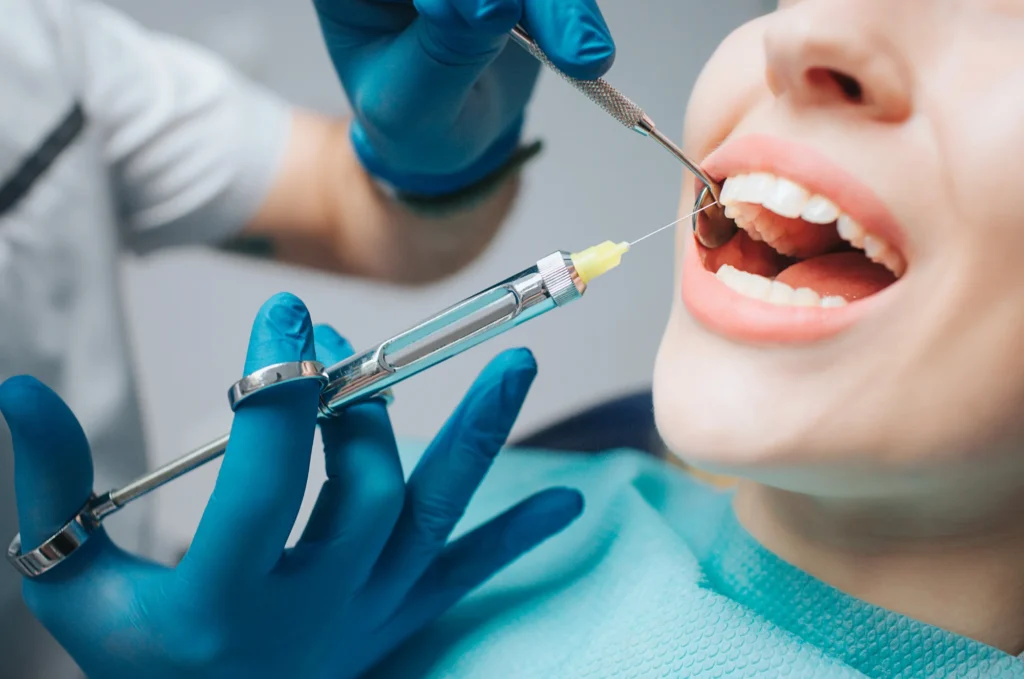
As with any surgical procedure, dental implant surgery carries some risk, though complications are uncommon and usually minor when they do occur. Possible risks include infection at the implant site, minor injury to nearby teeth or blood vessels, and temporary nerve sensitivity that can cause numbness or tingling in the lips, chin, or gums.
For implants placed in the upper jaw, there’s also a small chance of affecting a nearby sinus cavity. Most of these are treatable and become far less likely when the implant is planned and placed by an experienced provider. For a broader look at whether dental implants are safe, the risk profile here reflects the same pattern seen across implant dentistry generally. This risk profile is consistent with guidance published by the Mayo Clinic and the American Dental Association.
Every case looks a little different, but the tooth implantation process usually follows the same order from start to finish:
That’s the short answer to the question of what the process of getting dental implants is, but a few of these stages are worth a closer look.
A bone graft becomes necessary when the jawbone is too thin or too soft to hold an implant securely. The graft material, which can be synthetic or taken from another part of the body, gives new bone something to grow around over the following months. Once that area heals, it usually has sufficient density to support the implant in the same way a healthy jawbone would.
The implant teeth operation itself is a straightforward surgical procedure done under local anesthesia. After the area is numbed, the post is placed into a small channel prepared in the jawbone, and the gum is closed around it to protect the site as it heals. A protective cap or temporary tooth often covers the space in the meantime.
Dr. Waise Ebrahimi, who trained at UCSF and is certified in dental implant placement, typically completes this step in under an hour per implant, depending on the number of teeth involved. In cases that require more extensive grafting beforehand, an oral surgeon may address that portion before implant placement proceeds.
Most patients report more discomfort in the days after surgery than during the procedure itself, since the area stays numb throughout placement. Some swelling and soreness afterward are normal, similar to what follows a tooth extraction, not something sharper or longer-lasting.
Once healing is complete, the final restoration can be fixed or removable. A fixed crown is permanently attached to the abutment and functions like a natural tooth; it can’t be taken out for cleaning, but most patients prefer the feel of something that doesn’t move. A removable option, similar to a traditional denture but anchored to the implant, snaps securely into place and can be taken out for cleaning or overnight. Which one fits best usually comes down to how many teeth are being replaced and personal preference, and it’s a decision made together with your dentist before the final piece is fabricated.
The full dental implant surgery process, from the first exam to the final crown, typically takes 4 to 9 months. Grafting or a slower healing pace can add a few extra months to that window.
The first stage, consultation and imaging, usually takes a single 45- to 60-minute visit. If a tooth extraction is needed first, it adds its own healing window before implant placement can proceed.
This step, when the jawbone fuses with the implant, can’t be rushed. It usually takes three to six months, since it’s what gives the implant the strength of a natural tooth root. Once it’s finished, the abutment and final crown can move forward without delay.
Recovery after implant placement surgery, covered step by step in this dental implant recovery guide, is usually the more forgiving part of the healing process. Mild swelling, minor bleeding, and tenderness near the surgical site are common for the first few days. Sticking to soft foods and rinsing gently during that window helps everything heal without extra irritation.

Most patients need one to three days of lighter activity before returning to a normal routine, including a full Manhattan work schedule. Strenuous exercise is usually fine to resume after about a week, once the initial swelling has subsided.
Every implant process looks a little different depending on jawbone health, whether a tooth needs to come out first, and how many teeth are being replaced. Pricing follows a similar pattern, and a full breakdown is available in this guide to dental implant costs in Manhattan.
The clearest way to get a timeline specific to your mouth is a real consultation, not another search. Smile Lab, located in Union Square, offers that kind of visit for Manhattan patients who want a straightforward answer before committing to anything. Schedule a consultation and leave with an actual plan instead of a guess.